Before
- Proposals get written at night from photos and walk-through notes. A residential contractor on r/estimators says evening quotes take 1–2 hours each and go out too late.
- Change orders start on paper: 97% of trade contractors in Clearstory's 2025 survey (100+ US specialty contractors) still use paper T&M tickets, and teams spend 6–10 hours a week pricing and submitting change requests, plus up to 10 more chasing approvals.
- In the same survey 70% say most change requests go through two or three revision rounds, more than half take 8–14 days to turn a signed tag into a priced request, and 60% write down or write off change-order revenue at least occasionally.
- Clearstory sells change-order software and surveyed specialty trade partners, not remodelers only; read the numbers as direction, not a census.
After
- New proposal: photos and a scope note become a scope by trade and a low / likely / high proposal from the contractor's own price book, with allowances, exclusions, a payment schedule draft and a cover note.
- Change order: the field tag and photos become a backup-ready package the same day: description, reason, photo references, labour and material lines, schedule days, total, signature block and a message draft.
- Every line can be unticked and every message edited. The owner is editing a draft instead of assembling one, and nothing goes out on its own.
Sample projects (loads photos and scope note together)
Room photos (sample photo sets are labelled illustrations)
In production a vision model tags each photo. This demo does not analyse uploads: your photos are shown here only, never read, and they stay in your browser.
Pick a sample project or write a note.
Sample mid-job changes (loads the field T&M tag and site photos)
Site photos (sample illustrations; the paper tag photo is how most tags arrive)
Shown only, never analysed. In production a vision model reads the tag photo into the text below.
Pick a sample change.
Proposal range
Untick lines to adjust · optional lines start untickedPrices are illustrative, from a fictional price book. Tax not shown. The contract states one fixed price after the site visit and selections.
Cover note to the homeowner
Draft · not sentEdit freely. In a real build the owner approves it and sends it with the proposal from their own email.
Unticking a line updates the numbers here until you edit the text yourself.
Under the hood: parsed note, facts and lines JSON
Message to the homeowner
Draft · not sentGoes with the change-order PDF once the owner approves it. Unticking a line updates the totals here until you edit the text.
Nothing is sent from this page.
Under the hood: parsed tag and lines JSON
Price book (fictional)
How the drafts are built
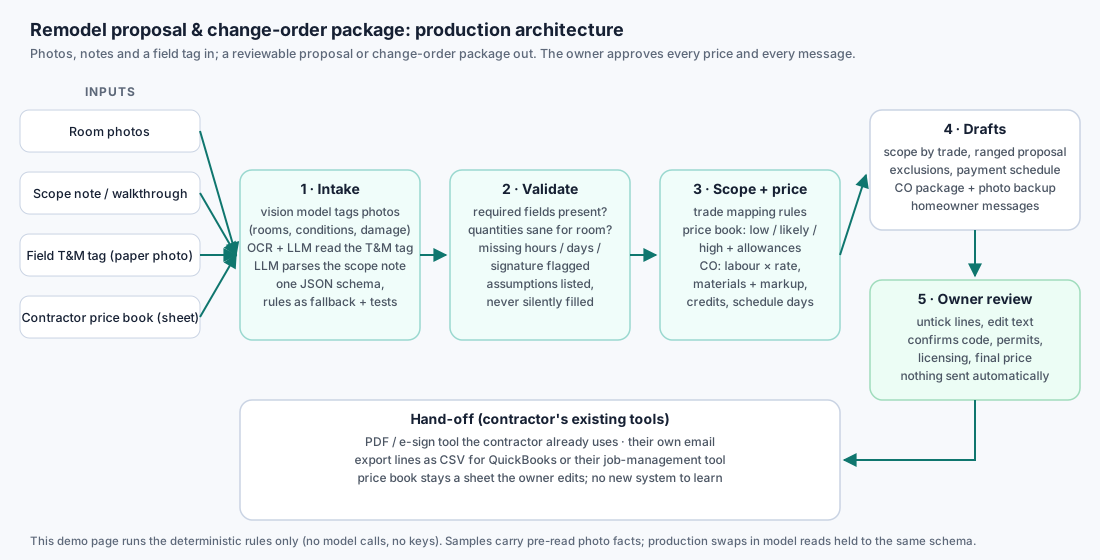
- Read. The scope note becomes structured JSON: homeowner, address (the ZIP picks the contractor), room, wanted items (wall removal, cabinet grade, counters, island, shower conversion, grab bars and so on), budget and timing. Each sample photo set carries pre-read facts: room size, cabinet and counter lengths, tile areas, year built, and conditions per photo (a load-bearing wall, a hood with no duct, a fan venting into the attic, a soft floor). The T&M tag is split into finding or request, work done, crew hours, materials, credits, schedule days and signature. This page uses deterministic rules; production uses a vision model for photos and the handwritten tag and an LLM for the note, all held to the same JSON schema, with the rules kept as a fallback and as test checks.
- Scope. Rules map each wanted item and photo condition to trade tasks and price-book lines, with quantities from the facts. Anything the rules had to guess goes in the "assumed" list instead of being filled in silently.
- Price. Each line has a low, likely and high unit price. Allowance lines (cabinets, counters, fixtures, tile, glass) are marked so the homeowner sees what depends on their selections. Change orders price crew hours at billing rates, materials at cost plus the contractor's markup, and subtract credits such as an unused allowance.
- Review. The owner unticks lines, edits the text, confirms local code, permit and licensing rules, and decides what to send. Nothing is sent from this page.
Production architecture